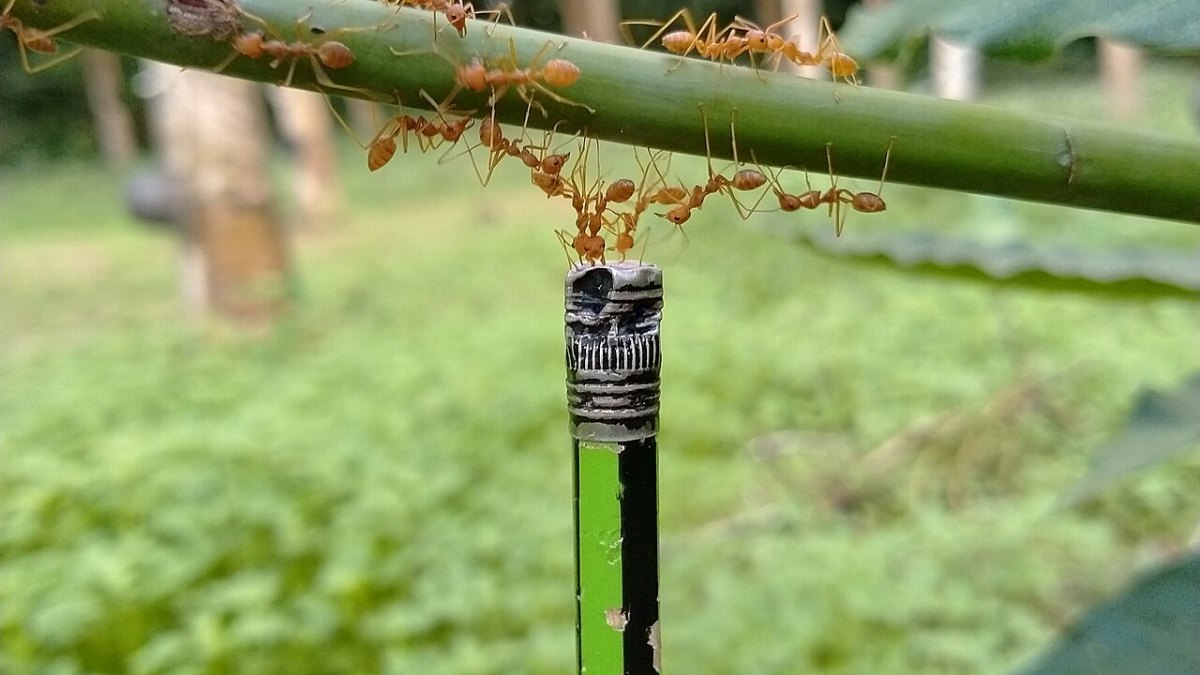
The viral claim that ants weigh 12 billion tons makes a great headline, and the population side of the comparison really does check out: a 2022 PNAS study by Schultheiss and colleagues, titled "The abundance, biomass, and distribution of ants on Earth," estimated about 20 quadrillion living ants worldwide (2 x 10^16). Divide that by a human population of roughly 8 billion and you get about 2.5 million ants per person. That ratio is the durable statistic worth keeping.
The Biomass Numbers, Corrected
Where the popular framing breaks down is weight. Schultheiss et al. pegged total ant biomass at roughly 12 megatons of dry carbon, or about 46 megatons wet. Human biomass sits near 390 megatons wet, so people actually outmass all ants by roughly 8 to 1. The "12 billion tons" figure appears to be a units mix-up that snowballed across blogs and social posts. The corrected ratio is still striking: ant dry-carbon biomass equals about 20% of the dry-carbon biomass of every wild bird and wild mammal combined.
Why the Earlier Estimates Were Higher
Hölldobler and Wilson, in their 1990 monograph "The Ants," calculated that ants and termites together account for roughly 10% of all animal biomass on Earth. That older figure leaned on extrapolations from tropical canopy fogging studies. The 2022 PNAS work synthesized 489 ground-level surveys from every continent except Antarctica, giving a tighter, lower number. Both estimates agree on the qualitative point: ants are one of the heaviest insect lineages by weight, even if they do not actually outweigh humanity.
Diversity and Deep Time
Roughly 14,000 ant species have been formally described, and entomologists estimate the true count near 22,000 once unsampled tropical forests are catalogued. Ants emerged in the Cretaceous around 140 million years ago. The oldest known ant fossil, Sphecomyrma freyi, was preserved in New Jersey amber roughly 92 million years ago and shows a transitional form between wasp-like ancestors and modern ants. By the time flowering plants diversified, ants were already present to exploit them.
Ecological Weight Class
Sheer numbers translate into outsized work. In some temperate and tropical systems, ants move more soil than earthworms do, turning over cubic meters per hectare each year. They disperse the seeds of about 30% of herbaceous plant species in temperate forests, a process called myrmecochory, in which seeds carry fatty appendages that ants haul back to their nests. They also suppress populations of caterpillars, aphids, and other insects, which is why removing ants from experimental plots tends to crash plant productivity within a season.
What the Numbers Actually Mean
So the takeaway flips the usual framing. Humans win the weight contest by a clear margin, but ants win every other category that matters ecologically: individual count, species count, geographic coverage, and per-gram metabolic throughput. A single mature leaf-cutter colony can contain 8 million workers and process more vegetation per day than a cow grazing the same plot. Multiply that across 20 quadrillion individuals and you get a planet that runs, in large part, on six legs.
Source: National Geographic, summarizing Schultheiss et al., PNAS 2022.
💬 Discussion (0)
Leave a Comment