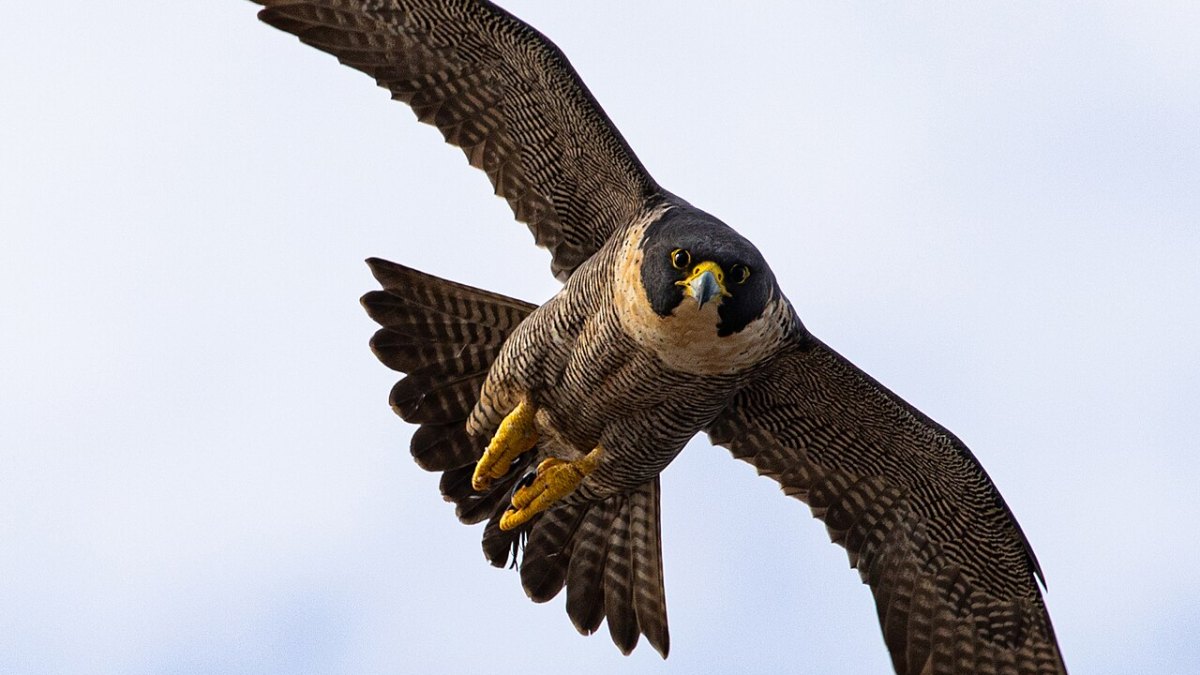
The peregrine falcon (Falco peregrinus) is, by raw speed, the fastest animal that has ever been measured. In its hunting dive — known as a stoop — it climbs to several hundred meters above its prey, folds its wings tight against its body in a teardrop shape, and falls. The current verified record for a stooping peregrine is 389 km/h (242 mph), recorded with calibrated GPS instruments on a falcon named Frightful, owned by skydiver and falconer Ken Franklin, in 2005.
For context: a Formula 1 car at full speed on the Italian Grand Prix straight tops out around 360 km/h. A free-falling human skydiver in standard belly-down position reaches terminal velocity at around 200 km/h; a head-down speed-flying skydiver tops out around 500 km/h only with practiced body shaping. The peregrine reaches over 380 km/h with a body the size of a crow.
Why it doesn't black out, drown, or shatter
A peregrine in a 380 km/h dive is generating air pressure and aerodynamic stresses that would tear most birds apart. Several anatomical features explain how it survives.
- Tubercles in the nostrils. Tiny bony cones inside each nostril deflect air sideways before it can ram down the trachea at supersonic-relative speeds. Without them, the bird would suffocate; jet engineers later borrowed the same principle to design supersonic intake cones.
- Nictitating membrane. A translucent third eyelid sweeps across the eye every few hundred milliseconds during the dive, clearing the cornea of debris and pressure-induced tears without losing visual lock on the prey.
- Reinforced keel. The breastbone is unusually thick and ridged, anchoring the powerful pectoral muscles that absorb the deceleration shock when the falcon flares its wings to pull out of the dive — a maneuver that subjects its body to roughly 27 g of acceleration.
- Aerodynamic feather geometry. The leading edge of each primary feather has a slight serration that delays airflow separation and reduces high-speed turbulence.
The strike
Peregrines do not catch their prey with talons mid-dive. They use the closed fist of their foot, balled up and rigid, as a club. At 380 km/h, the kinetic energy of a 1-kilogram bird is roughly 5,500 joules — comparable to a small handgun round. The strike is fatal on impact for most prey: pigeons, ducks, songbirds. The falcon then circles back to retrieve the carcass, which is often killed instantly mid-air and falls to the ground.
From near-extinction to skyscrapers
Peregrines were nearly wiped out across North America and Europe in the 1950s and '60s by DDT, which thinned their eggshells to the point that incubating parents crushed their own clutches. After DDT was banned in the U.S. in 1972, populations recovered remarkably. The species was removed from the U.S. endangered species list in 1999.
Modern peregrines have adapted spectacularly to human cities. They nest on the ledges of skyscrapers, cathedrals, and bridges — environments that mimic their natural cliff habitat. New York City alone has more than 20 nesting pairs; Chicago, London, and Berlin all support thriving urban populations that hunt feral pigeons in the canyons between buildings. The fastest animal alive is, with surprising frequency, doing 240 miles an hour right above your head.
💬 Discussion (0)
Leave a Comment