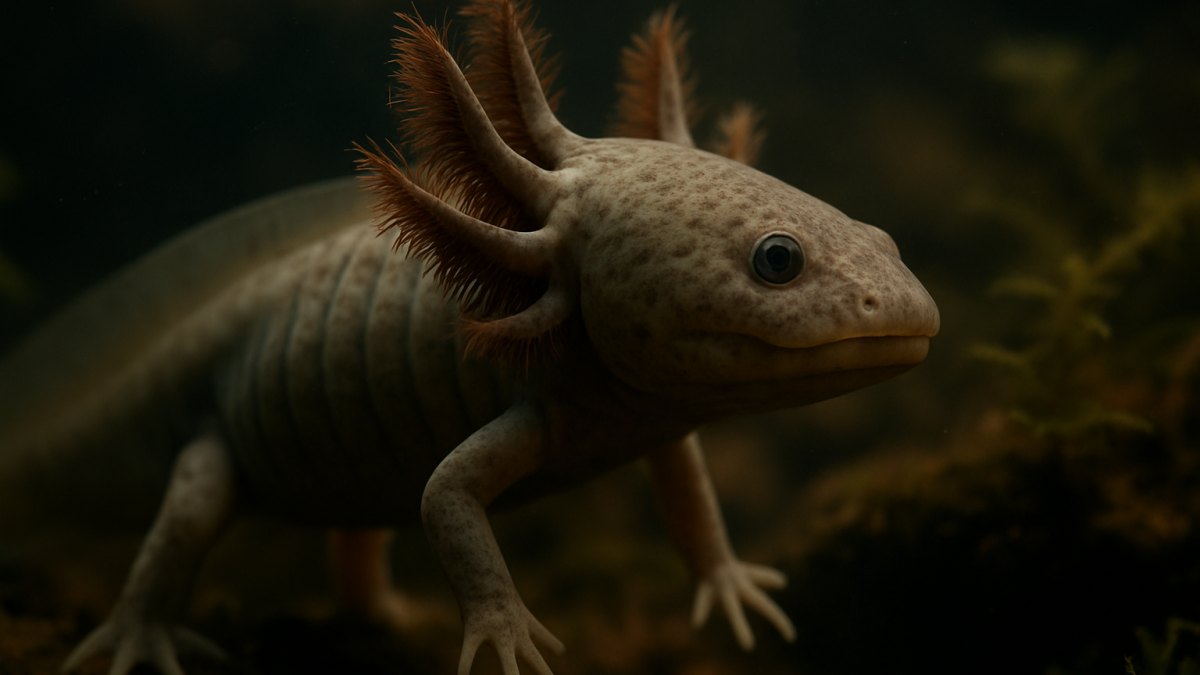
The axolotl (Ambystoma mexicanum) is a perpetually juvenile salamander native to the freshwater Lake Xochimilco system south of Mexico City. In the wild it is critically endangered. In laboratories around the world it is the single most studied vertebrate regeneration model on Earth.
Cut off an axolotl's leg and it grows back. Cut off the regrown leg and it grows back again. Researchers have repeated this on the same individual axolotl more than five times, and the new limbs are anatomically perfect each time — same number of digits, same nerve patterning, same bone density, no scar tissue, no detectable difference from the original.
The list of things axolotls regenerate
Axolotls have demonstrated complete or near-complete regeneration of:
- All four limbs, severed at any point along their length
- Tail, including its bone, muscle, nerves, and skin
- Spinal cord, fully transected
- Sections of heart muscle removed via laser ablation
- Lower jaw and parts of the upper jaw
- Lens of the eye, regrown from the iris
- Sections of brain tissue, including the telencephalon
- Sections of ovary and oviduct
The regrowth is driven by a structure called the blastema — a cluster of cells that forms over the wound site within hours and dedifferentiates back to a stem-cell-like state, then re-specializes into whatever tissue is needed: bone, cartilage, muscle, nerve, blood vessel, skin. Mammalian wounds, by contrast, lay down collagen fibers and seal the gap with scar tissue, which is faster but permanent.
The 32-billion-base-pair genome
In 2018, an international team published the axolotl genome in Nature. At 32 billion base pairs, it is roughly 10 times the size of the human genome — the largest animal genome ever fully sequenced at the time. Buried in that mountain of DNA are the regulatory networks that orchestrate regeneration: genes that switch on dedifferentiation, suppress scar formation, and re-pattern the lost limb based on positional memory in the surviving tissue.
One key player is a gene called FGF8, which axolotls keep active at wound sites; in mammals, FGF8 expression collapses after embryonic development, and limbs do not regrow. Another is the Pax7 network, which keeps muscle stem cells responsive into adulthood.
Why a human can\'t do this — yet
Mammals share most of the relevant genes with axolotls. The difference appears to be how those genes are regulated: humans evolved fast wound closure (anti-scarring is slow; scar tissue stops bleeding immediately) and stronger immune responses that interfere with the regeneration program. Researchers at the Max Planck Institute, the University of Vienna, and the Whitehead Institute are mapping the regulatory differences in hopes of switching specific human cell types into a more axolotl-like state.
The most concrete payoff so far: a 2022 study in Science showed that mouse hearts can regenerate damaged tissue if a small set of axolotl-style transcription factors are introduced. Translating any of this into human clinical therapy is decades away, but it is no longer science fiction. The animal that holds the answer is roughly 30 centimeters long, comes in a popular albino-pink variety beloved by aquarium hobbyists, and looks, depending on the angle, like it is either smiling or yawning at you.
💬 Discussion (0)
Leave a Comment