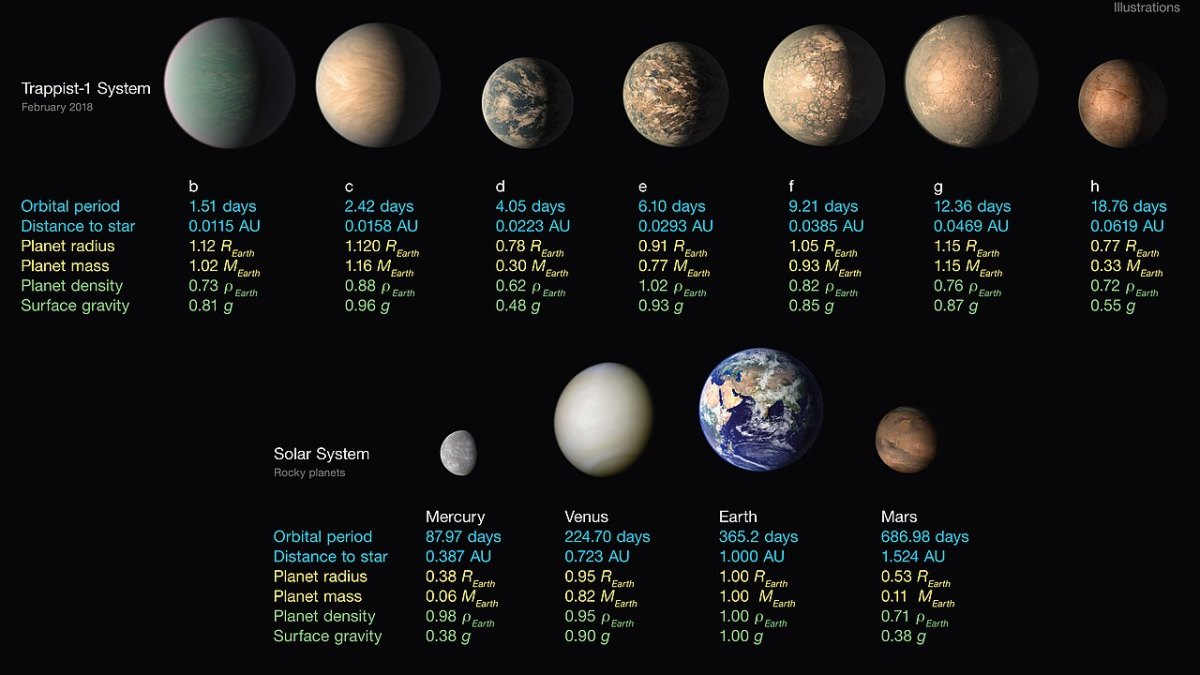
The star TRAPPIST-1 is unimpressive at first glance. It is a tiny ultracool dwarf about 9 percent the mass of the Sun and 12 percent its diameter — only slightly larger than Jupiter — emitting most of its light in the infrared. From Earth, even with a powerful amateur telescope, it is invisible. It sits 39 light-years away in the constellation Aquarius.
What makes it remarkable is what orbits it. In a paper published in Nature in February 2017, an international team led by Michaël Gillon at the University of Liège announced that TRAPPIST-1 hosts seven planets, all of them roughly Earth-sized, all of them rocky, and three of them — TRAPPIST-1e, f, and g — sitting squarely in the star's habitable zone where surface temperatures could permit liquid water.
How seven Earths fit around one star
Because TRAPPIST-1 is so dim and small, its habitable zone is much closer in than the Sun's. All seven planets orbit closer to their star than Mercury does to ours. Their years are absurdly short: TRAPPIST-1b completes an orbit in 1.5 Earth days. The outermost confirmed planet, TRAPPIST-1h, takes 18.8 days.
The system is so compact that an observer standing on one of the planets would see its neighbors as features larger than Earth's full moon in the sky. They tug on each other gravitationally with measurable effects, which is how astronomers determined their masses to within about 5 percent.
Tidal locking and the eternal sunset
All seven planets are believed to be tidally locked, the same way the Moon is to Earth — one face permanently turned toward the star, the other in eternal night. The boundary between the two, the terminator, would be a strip of perpetual twilight where temperatures might be most hospitable to liquid water and to life.
The day side of TRAPPIST-1d, for example, would experience constant noon under a star that fills 5 degrees of sky — about 10 times the apparent diameter of our Sun — but radiates only about 0.05 percent as much total energy. The result is an eternal sunset glow, redder than any Earthly sky.
What James Webb found, and what it didn\'t
Since 2022, the James Webb Space Telescope has been observing TRAPPIST-1 to characterize the planets' atmospheres. In 2023, JWST data ruled out a thick hydrogen atmosphere on TRAPPIST-1b — the innermost and most-irradiated planet. Results for the outer, cooler planets are still arriving. The system is the best laboratory we have for asking whether small, rocky, temperate worlds around small, cool stars can hold onto atmospheres at all, given the intense flares these dwarf stars are known to produce.
If even one of TRAPPIST-1's habitable-zone planets retains an atmosphere with biosignature gases, it would be the first concrete evidence that the universe routinely makes worlds where life could form. The light from our nearest interesting neighbor is 39 years old when it reaches Earth — close enough that a radio signal we send today would arrive while a child born this year is still alive.
💬 Discussion (0)
Leave a Comment