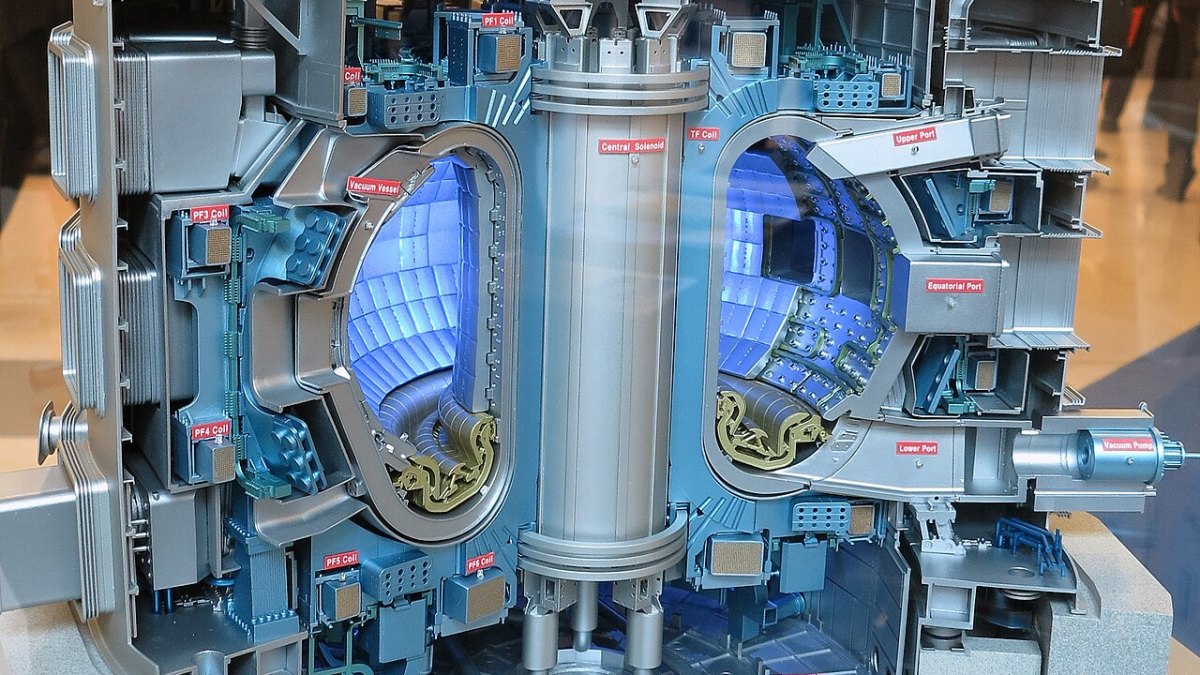
ITER — Latin for "the way" — is the world's largest scientific collaboration after the International Space Station. Thirty-five countries representing more than half the world's population are jointly funding a single experiment in Saint-Paul-lès-Durance, France: a tokamak fusion reactor whose central chamber will hold plasma at 150 million degrees Celsius. The Sun's core is about 15 million degrees. ITER's plasma will be ten times hotter.
Why ten times hotter than a star
Fusion in the Sun works at "only" 15 million degrees because the Sun has the gravitational pressure of 2 × 10^30 kilograms squeezing its core. We don't have that on Earth. To get hydrogen nuclei close enough to fuse without that pressure, we have to compensate with extreme heat — enough kinetic energy that protons overcome electrostatic repulsion and snap together, releasing helium and a torrent of energy.
The reaction ITER will run, deuterium plus tritium fusing into helium plus a high-energy neutron, produces 17.6 megaelectronvolts per fusion event. Per gram of fuel, that's the energy of roughly 10 tons of coal.
How you hold the hottest substance in the solar system
You cannot put 150 million degrees of plasma inside a metal chamber — any contact would instantly vaporize the wall and quench the plasma. ITER's solution is a magnetic bottle: superconducting niobium-tin coils, cooled to just 4 kelvins (-269°C), produce a magnetic field of 11.8 tesla that holds the plasma in a doughnut shape, never touching the wall. The temperature gradient between the plasma core and the magnets is around 150 million degrees over a few meters — believed to be the steepest temperature gradient anywhere in the universe.
Q = 10: the goal that has haunted physics for decades
The figure of merit for fusion is Q, the ratio of fusion power output to heating power input. Earlier reactors like the Joint European Torus (JET) achieved Q = 0.67 in 1997. The U.S. National Ignition Facility hit Q ≈ 1.5 in December 2022 — net energy gain at last, but using a different inertial-confinement laser approach.
ITER is targeting Q = 10: 500 megawatts of fusion power from 50 megawatts of plasma heating, sustained for at least 400 seconds. If achieved, it will be the first device in history to demonstrate that magnetic-confinement fusion can produce dramatically more energy than it consumes — the technical milestone needed before commercial fusion plants can be designed.
The 23,000-tonne machine
The ITER tokamak, fully assembled, will weigh 23,000 tonnes — three times the Eiffel Tower. First plasma is now scheduled for 2034 after multiple delays; deuterium-tritium operation begins around 2039. Total project budget has climbed past €20 billion. If it works, the prize is what fusion has always promised: a fuel source extracted from seawater, no carbon, no long-lived radioactive waste, and enough energy to last humanity until the actual Sun runs down five billion years from now.
💬 Discussion (0)
Leave a Comment