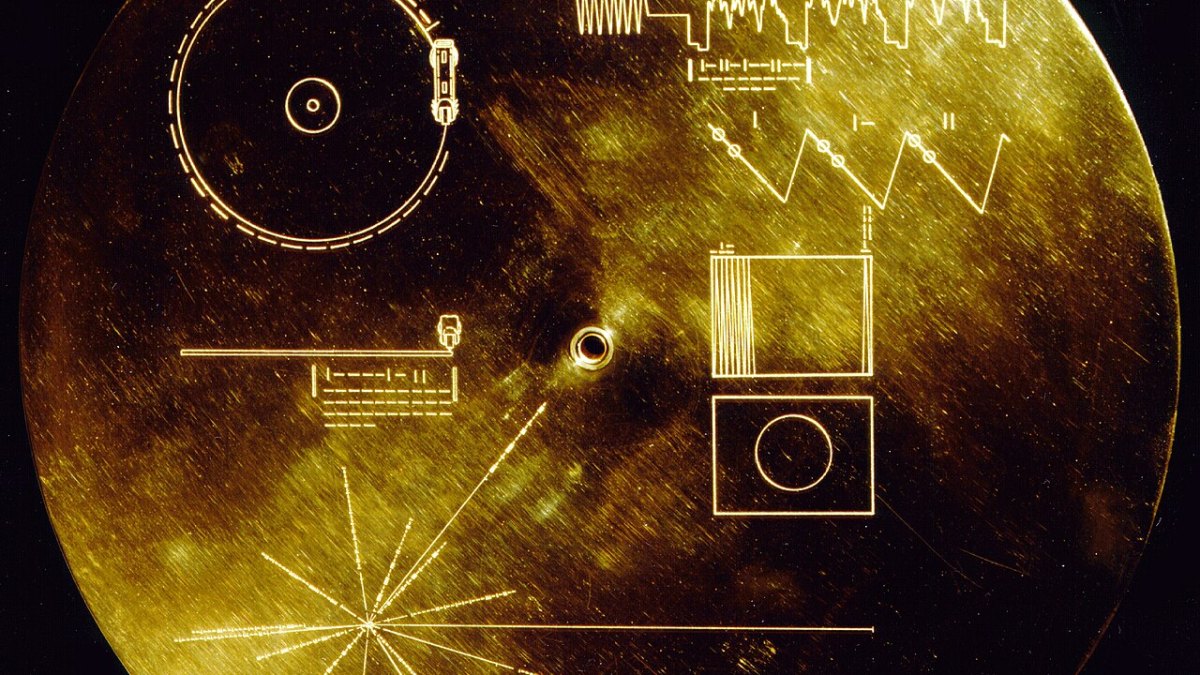
At this moment, a gold-plated copper phonograph record is drifting through interstellar space at roughly 61,000 kilometers per hour. It has been traveling since September 5, 1977, nearly 47 years, and as of 2024 sits more than 24 billion kilometers from Earth. A radio signal traveling at the speed of light takes over 22 hours to make the one-way trip. Voyager 1 crossed the heliopause, the boundary where the sun's influence gives way to the interstellar medium, on August 25, 2012, making it the first human-made object to enter interstellar space. Its twin, Voyager 2, launched slightly earlier on August 20, 1977, followed in 2018.
The Golden Record was not an afterthought. Carl Sagan chaired the NASA committee that designed it, working alongside astronomer Frank Drake, writer Ann Druyan, and a small team of scientists and artists. Their mandate was staggering: represent all of humanity, all of Earth's life, and the entire breadth of human culture on a single disc that might survive for approximately one billion years before micrometeorite erosion renders it unplayable. Sagan later described the project in his 1978 book Murmurs of Earth as a message in a bottle cast into the cosmic ocean.
What's on the Record
- 116 images: encoded in analog as audio signals, covering human anatomy, DNA structure, mathematical definitions, Earth's continents, a nursing mother, a supermarket, the Great Wall of China, and the Taj Mahal
- Greetings in 55 languages: ranging from ancient Akkadian and Sumerian to Cantonese, Arabic, Hindi, and English. UN Secretary-General Kurt Waldheim also contributed a spoken message
- 27 musical pieces: Bach's Brandenburg Concerto No. 2, Beethoven's Fifth Symphony, Chuck Berry's "Johnny B. Goode," Azerbaijani folk music, Senegalese percussion, Peruvian panpipes, Indonesian gamelan, Aboriginal songs from Australia, and a Navajo night chant
- Sounds of Earth: a heartbeat, whale song, wind, rain, surf, a train, a tractor, a kiss, laughter, a mother comforting a child, and the firing of a Saturn V rocket
- A stylus and playback instructions: etched directly onto the record's cover in binary and diagram form, showing any finder how to play it and how to decode the images
- Lifespan: approximately 1 billion years before significant micrometeorite degradation
The Music Selection
The 90-minute music program was the most contested part of the project. Ethnomusicologist Alan Lomax and others pushed hard for broader global representation. The final list spans 27 tracks across cultures and centuries. Chuck Berry's "Johnny B. Goode" generated controversy on the selection committee. Sagan's response, as recounted in Murmurs of Earth: "There are a lot of adolescents on the planet."
Where It Is Now
Voyager 1 is currently the farthest human-made object from Earth, traveling in a direction toward the constellation Ophiuchus. NASA's Deep Space Network still maintains contact, receiving a signal so faint that the receiver must detect a transmission at roughly 20 watts, about the power of a refrigerator light bulb, across 24 billion kilometers. That signal arrives 22 hours and 35 minutes after it leaves the spacecraft. NASA engineers confirmed in 2023 that Voyager 1 was transmitting garbled engineering data due to a corrupted memory chip; by April 2024, the team had successfully restored coherent communication by rerouting code around the damaged hardware, an extraordinary software patch executed across 24 billion kilometers of empty space.
In roughly 40,000 years, Voyager 1 will pass within 1.6 light-years of the star Gliese 445 in the constellation Camelopardalis. Whether anyone will be there to find it is entirely unknown. What is not unknown is what the record contains: evidence that in the autumn of 1977, a species on the third planet of an unremarkable star took the time to introduce themselves to the universe.
💬 Discussion (0)
Leave a Comment