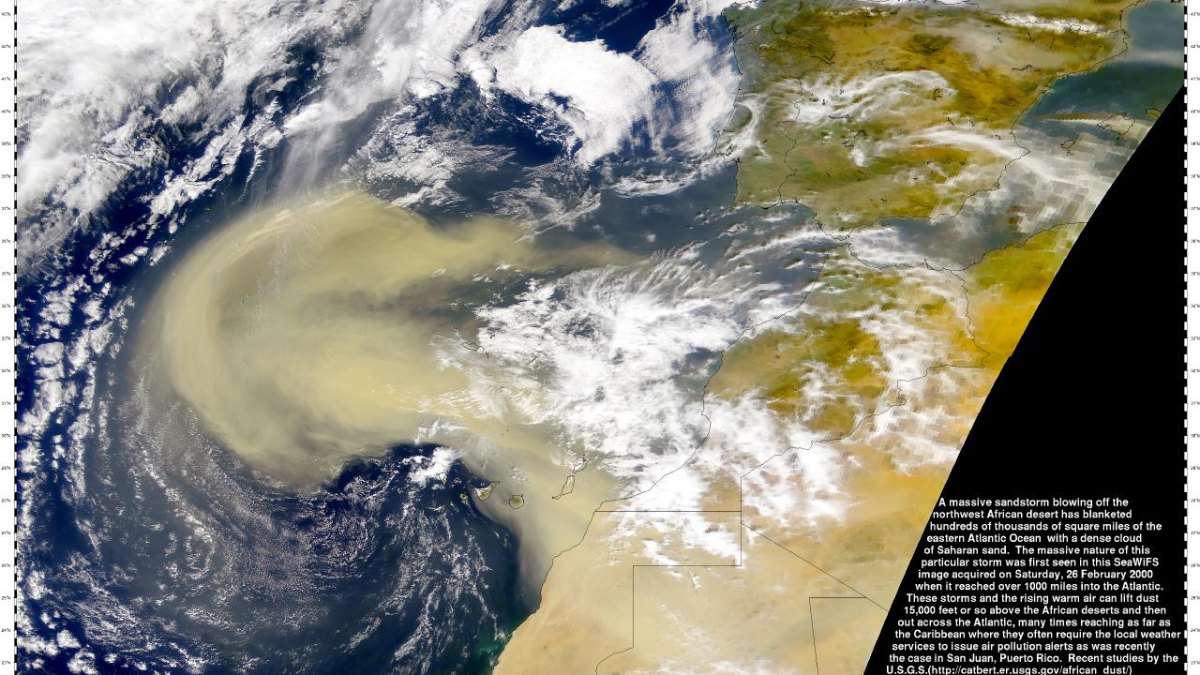
In June 2023, a massive sandstorm originating from the Sahara Desert embarked on a 5,000-mile journey across the Atlantic Ocean, dramatically affecting air quality upon its arrival in the Americas. This particular storm was notable not only for its size but for the sheer distance it traveled, impacting regions as far apart as the Caribbean, the southeastern United States, and parts of South America. The phenomenon, commonly referred to as the Saharan Air Layer (SAL), can transport up to 60 million tons of dust annually, influencing weather patterns and air conditions far from its origin.
The Journey of the Sandstorm
The sandstorm began its journey over the Sahara Desert, the world's largest hot desert, covering approximately 9 million square kilometers. The desert's dry and windy conditions are ideal for lifting sand particles into the atmosphere. The storm picked up momentum around June 15, 2023, when strong winds carried the dust across the Atlantic at altitudes of up to 20,000 feet. Traveling at speeds of 30 to 50 kilometers per hour, it took about a week for the dust to reach the Caribbean islands, including Puerto Rico and the Dominican Republic, where residents reported hazy skies and reduced visibility.
Impact on Air Quality and Weather
Upon reaching land, the sandstorm significantly affected air quality in several countries. In the Caribbean, air quality indices (AQI) rose to unhealthy levels, with particulate matter (PM10) concentrations exceeding 150 micrograms per cubic meter. In the southeastern United States, cities like Miami and Houston experienced hazy conditions and air quality advisories. The dust particles, rich in minerals like iron and phosphorus, also have a fertilizing effect on the ocean and land ecosystems. However, they can exacerbate respiratory issues, particularly in vulnerable populations. The presence of these particles in the atmosphere can also suppress storm formation, reducing hurricane activity temporarily in the Atlantic basin.
Long-term Environmental and Health Effects
The long-term effects of Saharan dust storms are a subject of ongoing research. Studies have shown that the mineral-rich dust can contribute to the health of the Amazon rainforest by replenishing nutrients depleted by rainfall. Conversely, the dust's impact on human health continues to raise concerns. Prolonged exposure to high levels of particulate matter is linked to respiratory and cardiovascular diseases. Monitoring organizations, like NASA's Earth Observing System, employ satellite technology to track these dust plumes, providing valuable data for predicting future storms and their potential impacts. Additionally, the interaction of dust with atmospheric systems may influence climate patterns, highlighting the need for more comprehensive studies.
- The Saharan Air Layer can transport dust particles at altitudes up to 20,000 feet.
- Caribbean air quality indices reached levels exceeding 150 micrograms per cubic meter of PM10.
- NASA uses satellite technology to monitor and predict future dust storms.
The journey of the Sahara sandstorm across the Atlantic is a powerful reminder of the interconnectedness of Earth's systems. While the immediate effects on air quality and weather patterns are evident, the long-term implications for ecosystems and human health underscore the need for continued research. Understanding these natural phenomena can aid in better preparedness and mitigation strategies, ultimately helping to protect both the environment and public health.
💬 Discussion (0)
Leave a Comment