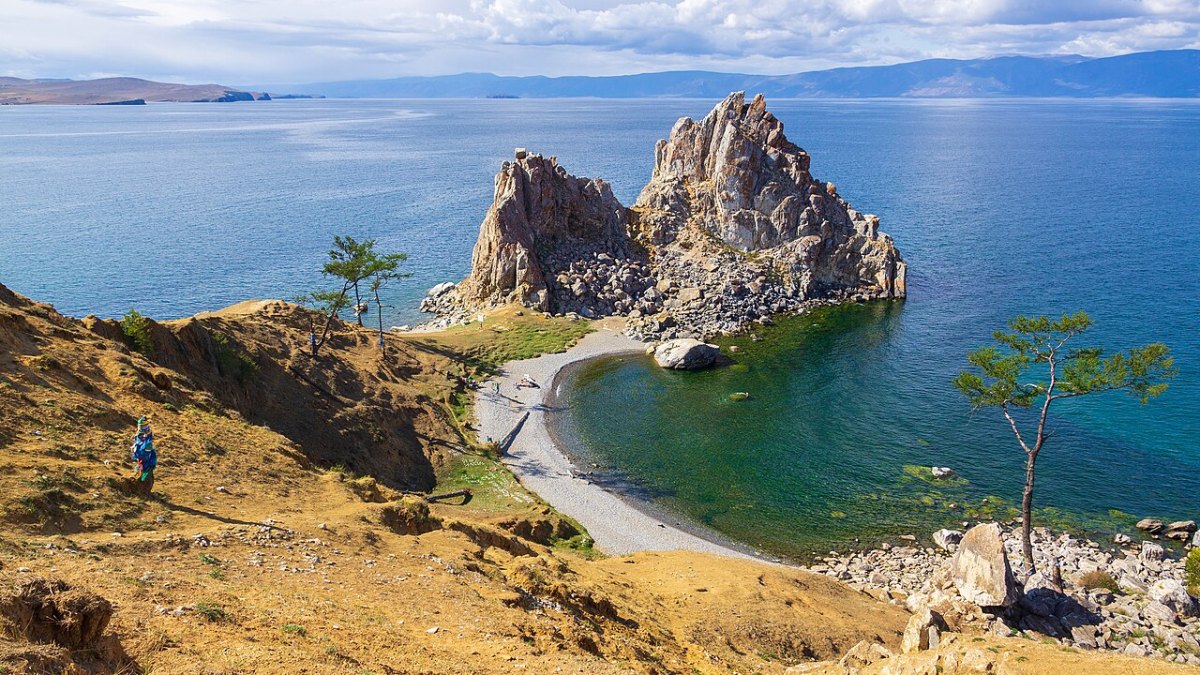
Lake Baikal sits in a rift valley in southern Siberia, Russia, stretching 636 kilometers from north to south and reaching a maximum width of 79 kilometers. At its deepest point, the lake plunges 1,642 meters (5,387 feet), nearly a mile and a half straight down. It holds an estimated 23,615 cubic kilometers of water, accounting for approximately 20% of all unfrozen surface fresh water on Earth. To put that in perspective, that volume exceeds the combined capacity of all five North American Great Lakes.
UNESCO designated Lake Baikal a World Heritage Site in 1996, describing it as the most outstanding example of a freshwater ecosystem. The lake began forming 25 to 30 million years ago, making it the oldest lake in the world by a wide margin. Most lakes last only a few thousand to tens of thousands of years before silting up or shifting geology closes them off. Baikal has persisted and deepened across geological epochs, and it continues to widen at roughly 2 centimeters per year as the tectonic plates beneath it pull apart.
The Numbers
- Depth: 1,642 m (5,387 ft), world's deepest lake
- Age: 25-30 million years, world's oldest lake
- Length: 636 km (395 miles)
- Surface area: 31,722 km², roughly the size of Belgium
- Freshwater volume: ~23,615 km³, ~20% of Earth's unfrozen surface freshwater
- Species: ~1,700 known species; approximately 80% found nowhere else
- Ice transparency: winter ice cover forms clear enough to see through up to 1 meter thick
- Ice season: 4 to 5 months per year, typically January through May
A Biodiversity Hotspot Unlike Any Other
The lake's extraordinary age and isolation have produced a degree of biological endemism that rivals oceanic islands. Of the roughly 1,700 plant and animal species documented in and around Baikal, approximately 80% are endemic, meaning they evolved here and exist nowhere else. These include the golomyanka, a translucent, oil-rich fish that gives birth to live young and can be found at depths exceeding 1,600 meters. The lake also supports dense populations of the tiny crustacean Epischura baikalensis, a native copepod that filters the water and plays a central role in keeping Baikal exceptionally clear. Horizontal visibility in the water can reach 40 meters in spring.
The Baikal Seal
No animal symbolizes Baikal's biological uniqueness more than the nerpa (Pusa sibirica), Earth's only exclusively freshwater seal. An estimated 80,000 to 100,000 nerpa live in the lake. How a marine mammal ancestor made its way into a landlocked Siberian lake millions of years ago remains a subject of scientific debate, though one leading hypothesis connects it to ancient waterways linking Baikal to Arctic seas during glacial periods. Adults can dive to 400 meters and hold their breath for up to 70 minutes.
Winter Ice and Light
Each winter, Baikal freezes over completely, typically by late January, and remains ice-covered through April or into May. The ice that forms is unusually clear, cold temperatures and calm conditions allow it to freeze with minimal snow cover and few air bubbles, producing slabs transparent enough to read through at thicknesses up to 1 meter. Cracks running for kilometers across the surface boom and groan as temperatures fluctuate.
Threats and Protection
Despite its protected status, Baikal faces pressure from tourism growth, industrial discharge from the surrounding watershed, and rising water temperatures. A paper pulp mill that operated on the southern shore for decades discharged treated effluent directly into the lake before closing in 2013. Algae blooms of Spirogyra, previously rare, have expanded along shoreline areas, a development researchers attribute to nutrient runoff and warming.
💬 Discussion (0)
Leave a Comment