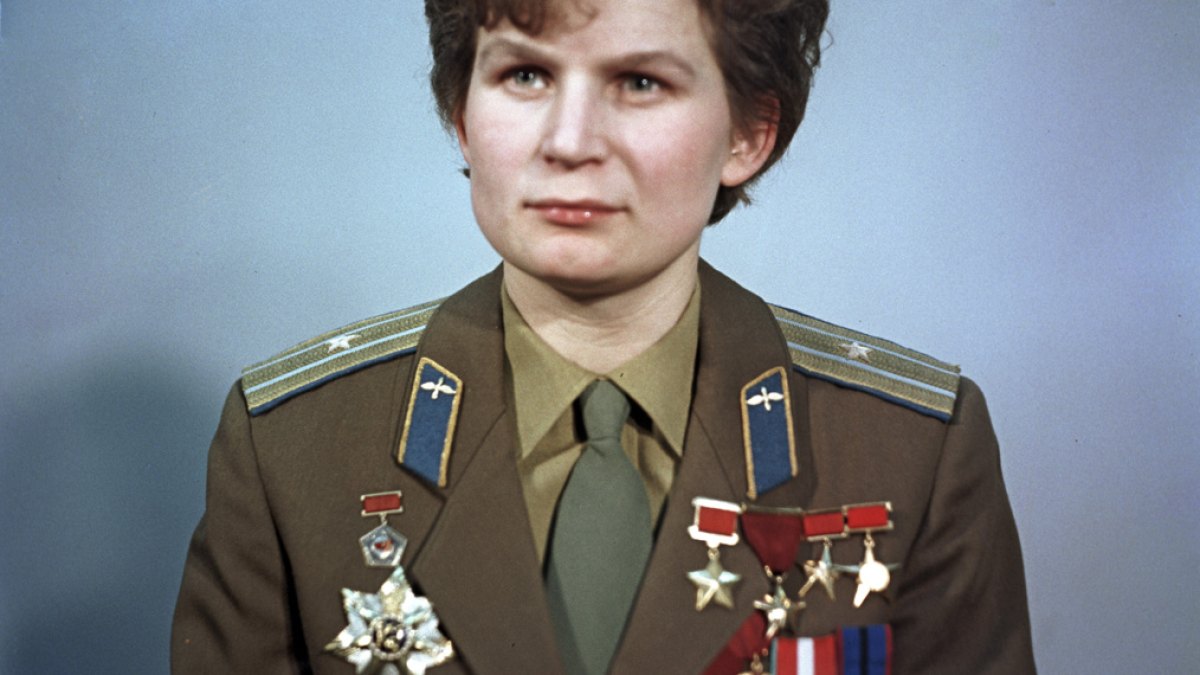
On the morning of June 16, 1963, Valentina Vladimirovna Tereshkova climbed into the Vostok 6 capsule at the Baikonur Cosmodrome in Kazakhstan and made history. She was 26 years old. Three years earlier, she had been threading looms at the Krasny Perekop textile mill in Yaroslavl. Now she was about to spend 70 hours and 50 minutes in orbit, circling the Earth 48 times before landing on June 19, logging more spaceflight time than all American astronauts who had flown to that date, combined.
Her call sign was Chaika, Seagull. The Soviet state broadcast her voice across the country.
How She Was Selected
The Soviet space program screened more than 400 female candidates in 1961 and 1962. Five were ultimately chosen for cosmonaut training. The selection criteria were strict and unusual: candidates had to be under 30, weigh less than 70 kilograms, stand no taller than 170 centimeters, and have documented experience in parachuting. That last requirement was not symbolic. Vostok capsules had no soft-landing system capable of safely bringing a cosmonaut to the surface inside the spacecraft. Pilots ejected at altitude and parachuted down separately.
Tereshkova had made over 90 parachute jumps as a member of the Yaroslavl Air Sports Club. She had no pilot's license and no engineering degree. What she had was documented freefall time, a working-class biography useful for Soviet propaganda, and unusual composure under pressure.
The Flight
Vostok 6 launched on June 16, 1963, one day after Vostok 5 had put Valery Bykovsky into orbit. The two spacecraft flew simultaneously, passing within 5 kilometers of each other at closest approach, the first time two crewed spacecraft had orbited concurrently. Tereshkova orbited at altitudes ranging from approximately 183 to 235 kilometers above Earth.
The flight was not without difficulty. According to accounts that surfaced decades later, including from Tereshkova herself in a 2004 interview, a software error in the automated orientation system was programmed to move the capsule away from Earth rather than toward it, which would have prevented reentry. She reported the problem to mission controllers, who transmitted a corrected program. The mission proceeded.
- Flight duration: 70 hours, 50 minutes
- Orbits completed: 48
- Age at launch: 26
- Parachute jumps before selection: 90+
- Training period: 18 months
- Previous occupation: textile mill worker, Yaroslavl
For context, the Mercury program's six flights totaled approximately 54 hours of spaceflight time across all astronauts through May 1963. Tereshkova surpassed that alone in a single mission. The Smithsonian National Air and Space Museum notes that no American woman would reach orbit until Sally Ride flew aboard the Space Shuttle Challenger on June 18, 1983, exactly 20 years and two days after Tereshkova's launch.
After Vostok 6
Tereshkova never flew again. In November 1963, she married fellow cosmonaut Andrian Nikolayev. Their daughter, Elena, born in 1964, was the first child born to two parents who had both been in space.
She moved steadily into Soviet and later Russian political life. She served in the Supreme Soviet, earned an engineering doctorate from the Zhukovsky Air Force Engineering Academy in 1977, and held multiple positions in government over the following decades. She remains the only woman to have flown a solo space mission. A crater on the far side of the Moon bears her name.
💬 Discussion (0)
Leave a Comment