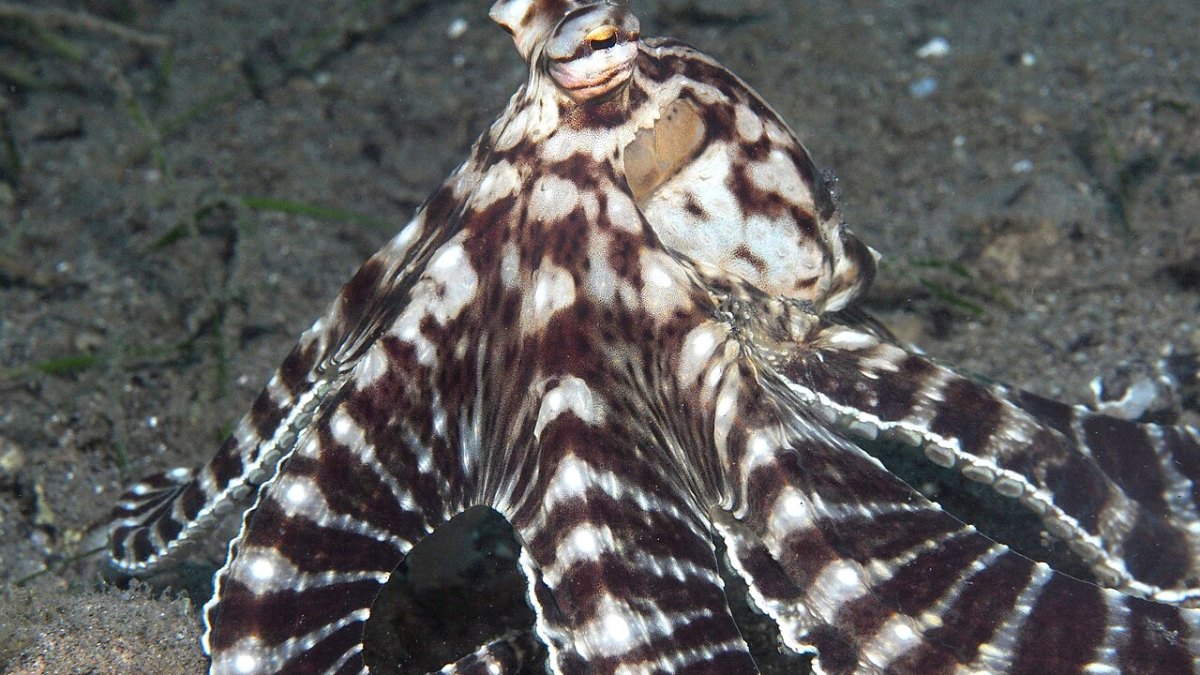
Off the coast of Sulawesi, Indonesia, in 1998, marine biologist Mark Norman spotted something in the shallow, silty coastal waters that did not fit any known animal behavior. A brown-and-white striped octopus, body roughly 60 centimeters tip to tip, was flattening itself, pulling six of its arms back, and extending the remaining two in opposite directions, each arm banded in alternating dark and pale stripes. It was imitating a banded sea snake, one of the most venomous animals in the Indo-Pacific ocean. Norman had found Thaumoctopus mimicus, the mimic octopus.
Norman and his colleagues documented the species formally and published findings in the Proceedings of the Royal Society B. What set T. mimicus apart from every other mimic in the animal kingdom was not merely that it could copy another species, but that it maintained a working library of at least 15 distinct impersonations and selected between them depending on the nature of the threat it faced. That is a level of contextual decision-making that had not been recorded before in invertebrate mimicry.
Who It Mimics
- Lionfish: The octopus spreads all eight arms outward and drifts slowly forward, replicating the silhouette and unhurried movement of a lionfish trailing its venomous spines.
- Flatfish: It compresses its body, holds its arms together in a leaf shape, and undulates across the seafloor in the distinctive rippling motion of a sole or flounder.
- Banded sea snake: Six arms are tucked into a burrow or pressed against the body; the remaining two are extended in opposite directions and held rigid, displaying the black-and-white banding that signals venom to any predator familiar with sea snakes.
- Jellyfish: The octopus rises into the water column, holds its arms in a bell shape above its body, and pulses gently downward.
- Sand anemone: Arms curl outward and stiffen, mimicking the radiating column of a large anemone anchored to the substrate.
- Additional species in the documented repertoire include stingrays, mantis shrimp, feather stars, and tube worms, with postures and coloration patterns adjusted for each.
Context-Dependent Choice
The most striking element of Norman's findings was that the octopus does not rotate through its impersonations at random. It chooses based on what is attacking it. When a group of damselfish harassed the animal during observation dives, it consistently shifted into the banded sea snake display, because banded sea snakes are a known predator of damselfish. The octopus was not just mimicking; it was selecting the specific predator most relevant to the attacker in front of it.
Why the Sandy Shallows
T. mimicus lives in the nutrient-rich but visually exposed estuarine and coastal environments of the Indo-Pacific, particularly around Indonesia and the broader Coral Triangle. Unlike reef octopuses that can retreat into crevices, the mimic octopus often forages across open, featureless mudflats where there is nowhere to hide. The mimicry library is effectively a substitute for a rock to hide under.
What It Tells Us
Before T. mimicus, mimicry in invertebrates was treated largely as a fixed trait: an animal either looked like something dangerous or it did not. Norman's documentation of flexible, threat-responsive mimicry in a cephalopod pushed the boundary of that framework. The octopus has no centralized vertebrate brain, yet it gathers sensory information about an attacker, matches it against a stored behavioral pattern, and executes a physically precise impersonation, sometimes within seconds.
💬 Discussion (0)
Leave a Comment