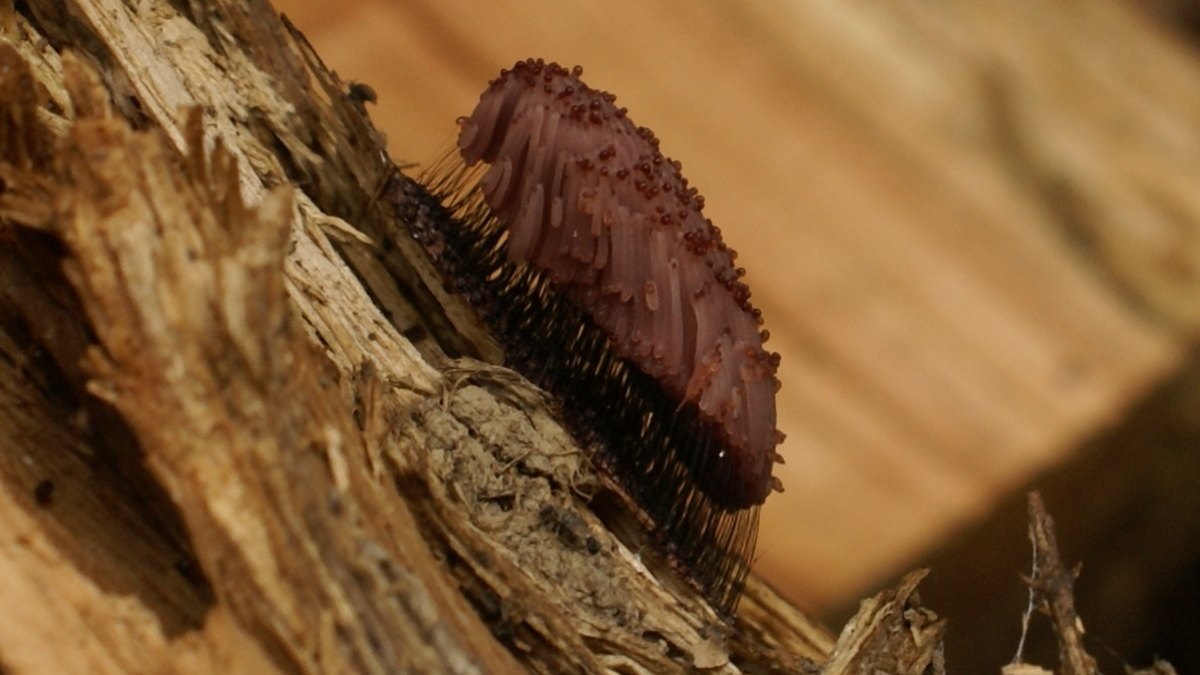
In 2000, biologist Toshiyuki Nakagaki and colleagues at Hokkaido University placed a specimen of Physarum polycephalum, a bright yellow slime mold, inside a maze carved from agar. Food sources were placed at two exits. Within hours, the organism had explored every corridor of the maze simultaneously. Within 26 hours, it had retracted its body from every dead end and inefficient route, leaving a single continuous tube of living tissue tracing the shortest path between the two food sources. The findings were published in Nature in 2000 and drew immediate attention from mathematicians, computer scientists, and biologists alike.
Physarum polycephalum is technically a single cell. One enormous cell containing millions of nuclei, no walls dividing it into separate compartments, and absolutely no neural tissue of any kind. It has existed on Earth for roughly 500 million years. It feeds on bacteria, fungal spores, and decaying plant matter. It moves at a top speed of roughly 1 centimeter per hour. And yet, faced with a spatial optimization problem that stumps conventional algorithms, it finds the answer reliably and efficiently.
How It Works
The mechanism behind Physarum's problem-solving is mechanical, not cognitive. The organism extends fan-shaped sheets called pseudopods in all directions simultaneously, probing its environment for nutrients. As food signals are detected, the tubes connecting nutrient sources strengthen. They widen and carry cytoplasm more rapidly. Tubes that lead nowhere useful experience less flow, thin out, and are eventually reabsorbed. The organism is, in effect, running a continuous physical computation: reinforcing what works and discarding what does not, using chemical gradients and fluid pressure as its calculating medium.
- Time to solution: The organism identified and committed to the shortest path within 4 hours of initial contact with both food sources.
- Efficiency ratio: The path selected by Physarum matched the mathematically shortest route in every trial run.
- Organism size: A single Physarum specimen can spread across several square meters while remaining one continuous cell.
The Tokyo Rail Test
In 2010, Nakagaki's team published a follow-up study in Science that pushed the question further. The researchers laid out a flat surface representing the greater Tokyo region and placed oat flakes, a food source Physarum responds to strongly, at positions corresponding to the 36 major population centers surrounding Tokyo, including the locations of real metro stations. They then introduced a Physarum specimen at the position corresponding to Tokyo central station and waited.
Over the next 26 hours, the organism grew outward, connected the food sources, tested configurations, and pruned back inefficient links. The final network of tubes it produced closely replicated the actual Tokyo rail system, including the major trunk lines, the bypass routes, and the balance between redundancy and efficiency that human engineers had spent decades refining. The 2010 Science paper, titled "Rules for Biologically Inspired Adaptive Network Design," argued that the organism applies implicit engineering principles: fault tolerance, transport efficiency, and cost minimization.
Why It Matters
Computer scientists have used Physarum's behavior as the basis for new network routing algorithms that are more adaptive and fault-tolerant than conventional approaches. The organism's method of solving optimization problems without centralized control is relevant to distributed computing, robotics swarm design, and infrastructure planning. It also forces a rethinking of what intelligence requires. Physarum polycephalum solves the shortest-path problem using physics, chemistry, and fluid dynamics operating across a living membrane. The solution emerges not from computation in any conventional sense, but from the organism's physical structure responding to its environment in real time. Nakagaki received the Ig Nobel Prize in 2008 for the work.
💬 Discussion (0)
Leave a Comment