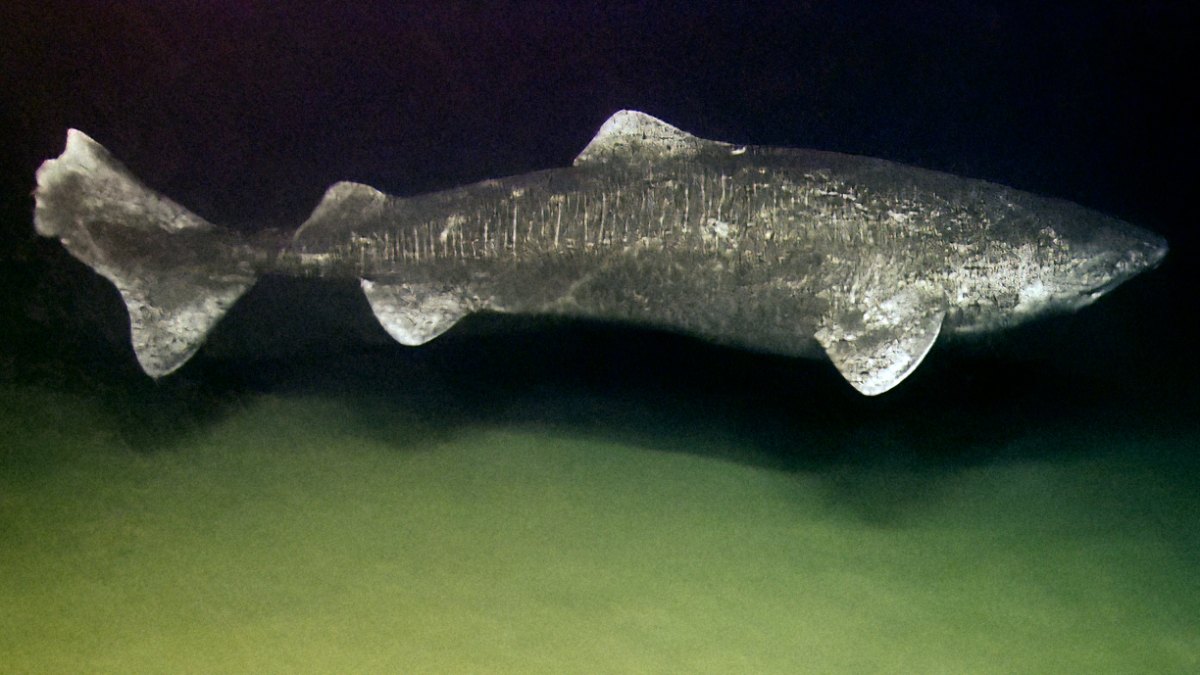
In 2016, marine biologist Julius Nielsen and his colleagues published a study in Science that quietly rewrote the record books. Among 28 Greenland sharks caught as bycatch in the North Atlantic and Arctic, one female was estimated to be 392 years old. The uncertainty range on that estimate ran from 272 to 512 years. Even at the conservative end, she was born before the Pilgrims landed at Plymouth Rock. At the upper end, she entered the water sometime around the reign of Henry VIII.
The Greenland shark (Somniosus microcephalus) is now recognized as the longest-lived vertebrate on Earth, surpassing the previous record holder, the bowhead whale, which has been documented at around 211 years. What makes the Greenland shark's longevity striking is not just the number itself but what the animal must do, or rather not do, to achieve it.
How They Dated Them
Traditional aging methods for fish rely on growth rings in hard structures like otoliths or vertebrae. Greenland sharks have soft skeletons made of cartilage, which leaves no such record. Nielsen's team turned instead to the eye lens nucleus, a structure made of crystallin proteins that forms before birth and is metabolically inert from that point forward. These proteins incorporate carbon from the environment at the moment they form and do not exchange it afterward, making them a reliable biological time capsule.
The team used radiocarbon dating on lens samples from all 28 sharks. For the larger, older animals, they cross-referenced their readings against the bomb pulse: the sharp spike in atmospheric carbon-14 caused by above-ground nuclear weapons testing in the 1950s and early 1960s. Sharks whose lenses showed no trace of that pulse were born before the tests began, placing them solidly in the pre-1950s bracket.
- Maturity: Sexual maturity is reached at approximately 150 years of age, making the Greenland shark one of the latest-maturing animals known to science
- Growth rate: Roughly 1 cm per year, among the slowest of any shark species
- Size: Adults typically reach 4 to 5 meters in length, with some exceeding 6 meters
- Habitat: Deep Arctic and sub-Arctic waters, often at temperatures as low as -1°C, recorded at depths exceeding 2,000 meters
- Diet: Opportunistic scavengers and slow predators; seal remains, fish, and even horse and polar bear tissue have been found in stomach contents
The combination of near-freezing water temperatures and an exceptionally slow metabolism is likely central to the animal's lifespan. Cold slows nearly every biochemical process, including the accumulation of cellular damage that underlies aging in most vertebrates. The shark's metabolic rate is so low that it moves at an average speed of roughly 0.3 meters per second, earning it the nickname "sleeper shark" in some regions.
Why It Matters
For aging researchers, a vertebrate that suppresses cellular deterioration for four centuries is a compelling subject. Understanding the molecular mechanisms behind extreme longevity in sharks could shed light on the pathways that govern aging in other vertebrates, including humans. For conservationists, the findings carry a more urgent message. A species that does not reproduce until age 150 is extraordinarily vulnerable to overfishing. Greenland sharks are frequently taken as bycatch in bottom trawls and on longlines targeting Greenland halibut. The IUCN lists the species as Near Threatened.
Somewhere in the dark, cold water beneath the Arctic ice, there are sharks alive today that were born before the telescope was invented, before the Thirty Years' War, before most of the modern world took its current shape. They are not doing anything dramatic. They are just swimming, very slowly, and waiting.
💬 Discussion (0)
Leave a Comment