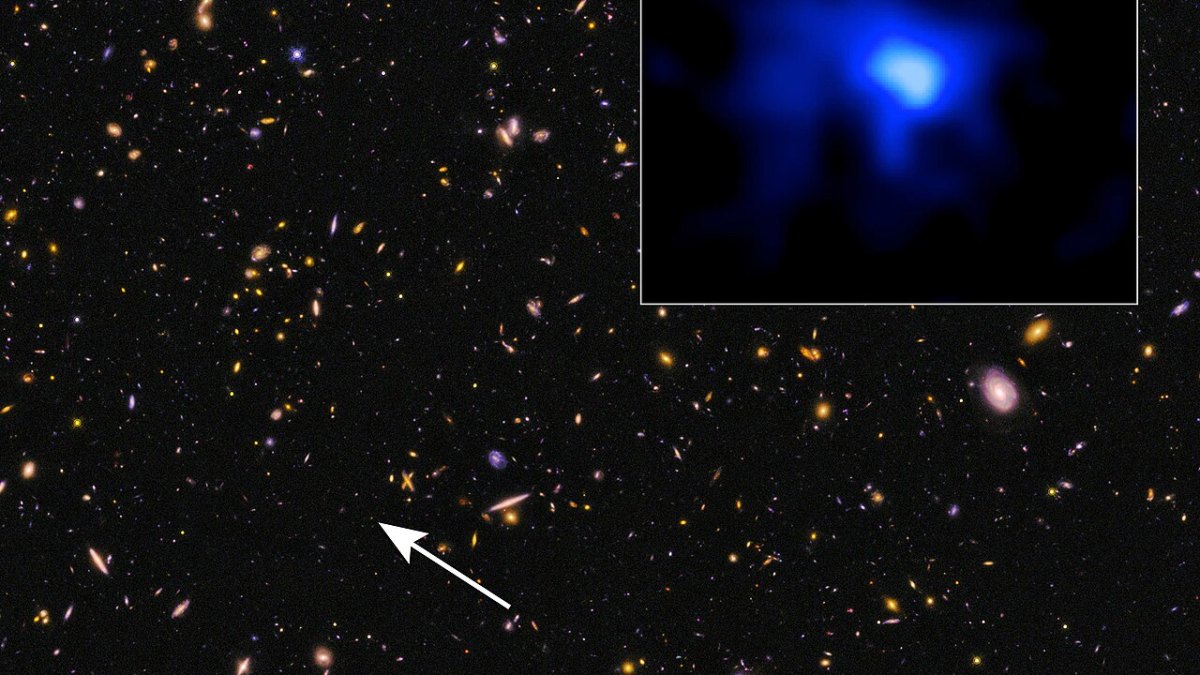
Astronomers have made a remarkable discovery with the identification of a colossal black hole that weighs an astonishing 40 billion times the mass of our sun. This gigantic cosmic entity, located in the galaxy Holm 15A, is now the largest black hole ever recorded. The discovery was made possible through sophisticated telescopes and advanced algorithms that allowed scientists to measure the gravitational effects of the black hole on its surrounding galaxy. With such an immense mass, this black hole challenges current theoretical models of black hole formation, prompting scientists to revisit and refine their understanding of these enigmatic celestial objects.
The Discovery of Holm 15A's Supermassive Black Hole
The black hole was discovered by a team of astronomers using the Very Large Telescope (VLT) in Chile, operated by the European Southern Observatory. By analyzing the velocity of stars orbiting the black hole, researchers were able to estimate its mass. The galaxy Holm 15A, situated in the center of the Abell 85 galaxy cluster approximately 700 million light-years away, provides a unique environment for such a massive black hole to exist. The central region of this galaxy has been observed to have very few stars, suggesting that the black hole's immense gravitational pull could have cleared the area, further indicating its extraordinary size.
Implications for Black Hole Formation and Growth
The discovery of a black hole of this magnitude has significant implications for our understanding of black hole formation and growth. Traditionally, black holes are thought to form from the remnants of massive stars and grow by accreting matter from their surroundings or merging with other black holes. However, the sheer size of this black hole suggests alternative formation mechanisms might be at play. Some scientists propose that it could have formed from the direct collapse of vast amounts of gas in the early universe, bypassing the star stage entirely. This discovery encourages further exploration into the processes that could lead to the creation of such enormous black holes.
Challenges in Observing and Measuring Black Holes
Measuring the mass of black holes, especially those located at such great distances, poses significant challenges. The team employed a technique known as stellar dynamics, which involves studying the motion of stars in the vicinity of the black hole to infer its mass. This method requires precise measurements and sophisticated modeling to account for the influences of nearby galactic structures. Despite these challenges, advances in technology and observational techniques have enabled astronomers to detect and analyze these massive objects with increasing accuracy. The discovery of this supermassive black hole highlights the importance of continued investment in astronomical research and technology.
The identification of a black hole weighing 40 billion solar masses not only sets a new record but also opens new avenues for scientific inquiry. As researchers continue to explore the cosmos, discoveries like this one deepen our understanding of the universe and its myriad wonders. With each new finding, the mysteries of black holes become slightly less opaque, bringing us closer to unraveling the secrets of these fascinating celestial phenomena.
- This black hole is located in the galaxy Holm 15A, 700 million light-years away.
- The European Southern Observatory's Very Large Telescope was integral to this discovery.
- Current theories of black hole formation are challenged by the size of this entity.
- Stellar dynamics were used to measure the black hole's mass.
- Holm 15A's central region is largely devoid of stars, indicative of the black hole's influence.
💬 Discussion (0)
Leave a Comment