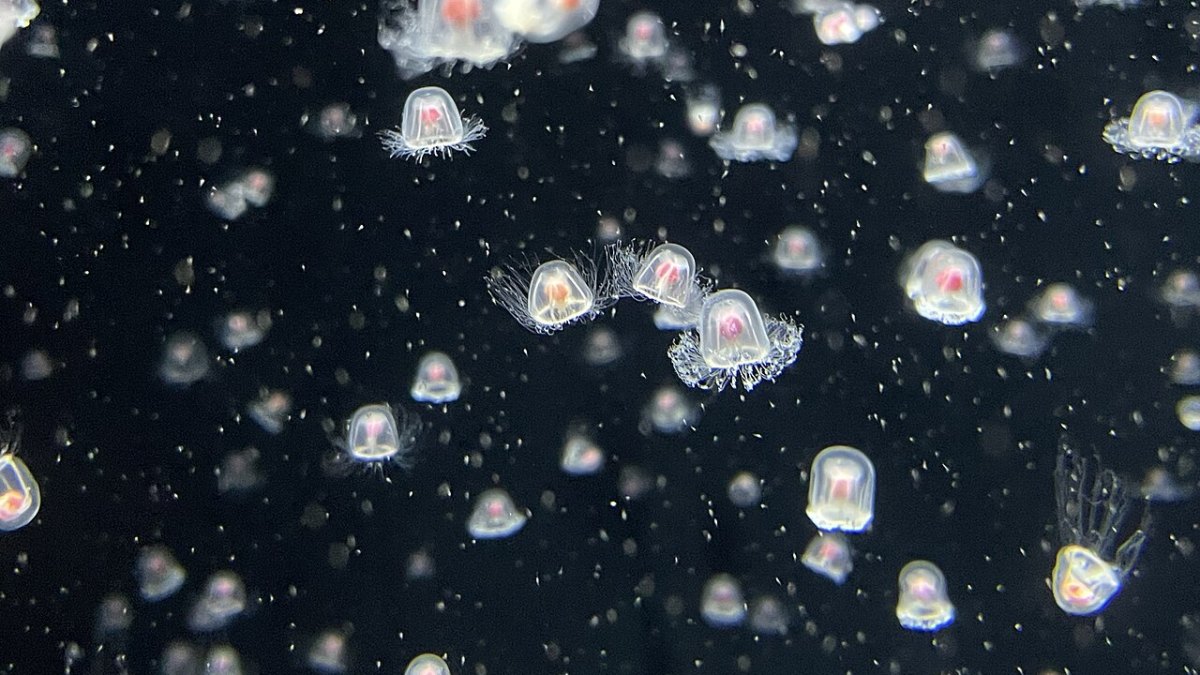
Pulled from a tank, Turritopsis dohrnii looks unimpressive: a translucent bell about 4.5 mm wide, fringed with roughly 10 tentacles, drifting in the family Oceaniidae. Native to the Mediterranean, it has spread to temperate and tropical seas worldwide since the 1990s, hitchhiking in the ballast water of cargo ships. Its claim on biology textbooks is not size or beauty but a stubborn refusal to grow old in the usual one-way direction.
How a medusa walks back its life cycle
The mechanism is transdifferentiation, not a "DNA reset." When an adult medusa is hit by stress — starvation, injury, or a sudden temperature swing — its differentiated cells revert to an earlier developmental state. Within roughly 24 to 72 hours, those cells reorganize on the seafloor as a polyp, and the polyp then buds off new genetically identical medusae. Italian researcher Stefano Piraino and colleagues first documented the full reversion in 1996, turning a curious aquarium observation into a reproducible result.
"Immortal" is a marketing word
The accurate phrase is biologically immortal: the species shows no senescence, meaning no programmed decline with age. In a real ocean, that distinction matters. Predation by larger jellyfish and sea slugs, bacterial infection, and disease still kill Turritopsis dohrnii at every stage. Not every individual reverts, either; reversion is a stress response, not a default behavior, and only a fraction of stressed adults complete the loop back to the polyp form before dying.
No senescence is not the same as no death. Roughly 1 in 1 jellyfish, given enough time and bad luck, still ends up eaten.
What the 2022 genome revealed
In 2022, a Spanish team led by María Pascual-Torner at the Universidade de Oviedo sequenced the species' genome and compared it to its close cousin T. rubra, which ages and dies normally. The headline finding: T. dohrnii carries roughly double the copies of several DNA-repair genes, plus expanded sets tied to telomere maintenance and mitochondrial upkeep. Two related medusae, separated by a handful of gene duplications, end up on opposite sides of the aging line.
Why cell biologists keep watching
The interest beyond marine biology is straightforward. Adult cells dedifferentiating and then redifferentiating into a new body plan is, mechanically, what stem-cell researchers try to coax in a dish. Labs studying cellular aging and cancer treat Turritopsis dohrnii as a natural reference for two questions at once: how a cell safely walks back its identity, and how a genome with extra repair capacity holds off the damage that drives tumor formation.
- Bell width: about 4.5 mm, with roughly 10 tentacles.
- Range: Mediterranean origin; now global, spread via ballast water since the 1990s.
- Trigger: starvation, injury, or thermal shock — not a daily routine.
- First documented reversion: 1996, Stefano Piraino et al.
- Genome: sequenced 2022; ~2x DNA-repair gene copies vs. T. rubra.
Calling a 4.5 mm jellyfish immortal flattens a more interesting story. Turritopsis dohrnii has bought itself an exit ramp from old age that most animals do not have, paid for by extra DNA-repair hardware and a willingness to dissolve its own adult body when conditions turn hostile. It still gets eaten, infected, and stranded — but on the question of senescence alone, this millimeter-scale drifter has, so far, opted out.
💬 Discussion (0)
Leave a Comment