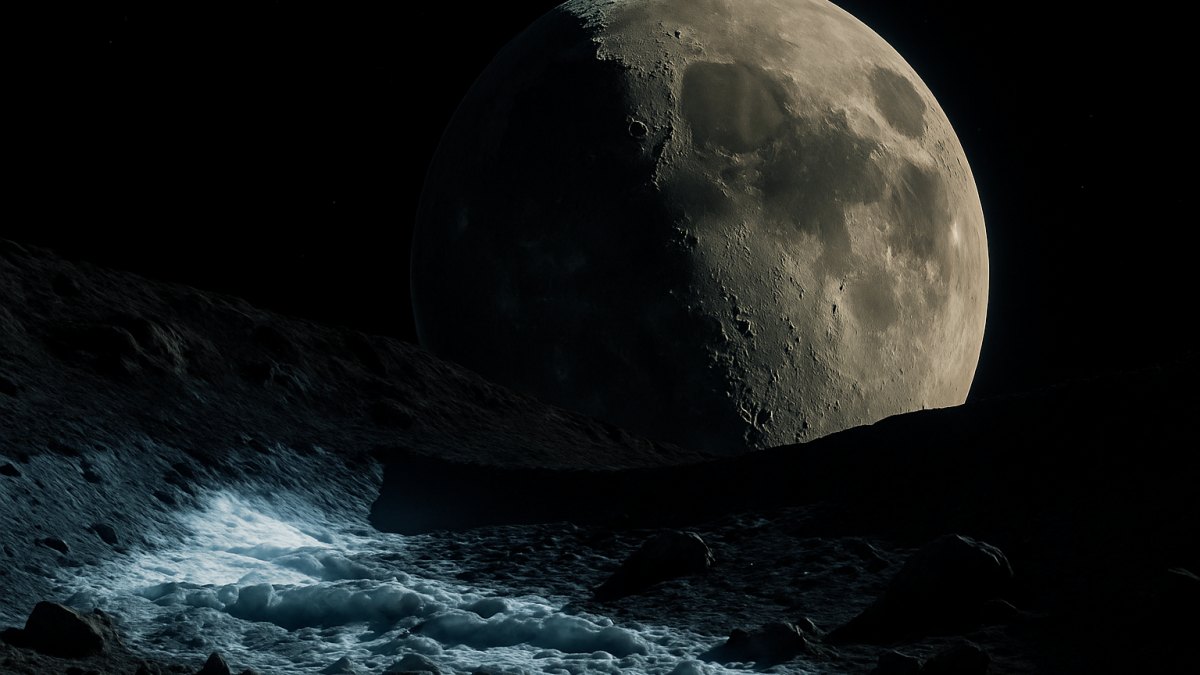
In a landmark discovery, scientists have identified approximately 600 million metric tons of water ice on the moon's far side, specifically in its permanently shadowed regions. This finding, announced in October 2023, has significant implications for future lunar exploration and potential colonization. The presence of water ice could provide essential resources for sustaining human life and facilitating the production of rocket fuel. The research team utilized data from NASA's Lunar Reconnaissance Orbiter and the Indian Space Research Organisation's Chandrayaan-2 to confirm the presence of ice in these shadowed craters, which never receive direct sunlight, preserving the ice for millions of years.
How Researchers Detected the Ice
The detection of water ice on the moon's far side was achieved using advanced remote sensing techniques. Instruments aboard the Lunar Reconnaissance Orbiter, such as the Diviner Lunar Radiometer Experiment, played a crucial role in identifying the thermal characteristics of the moon's surface. Additionally, the Moon Mineralogy Mapper on Chandrayaan-2 provided spectroscopic evidence of water molecules. By analyzing reflected sunlight and thermal emissions, researchers could distinguish between different surface materials and confirm the presence of ice. This method of detection is crucial because direct sampling in these regions is currently impossible due to extreme cold and lack of sunlight, which demand novel approaches to lunar exploration.
Implications for Lunar Exploration and Colonization
The discovery of water ice in these permanently shadowed regions opens new opportunities for lunar exploration and colonization. Water is a critical resource, not only for sustaining life but also because it can be split into hydrogen and oxygen to produce rocket fuel. This makes the moon a potential refueling station for deep space missions, significantly reducing the cost of space travel. The presence of water ice could also support long-term lunar habitats, providing essential resources for human settlers. The potential to create a sustainable human presence on the moon is now more feasible, thanks to this discovery, encouraging international cooperation in lunar exploration efforts.
Challenges and Future Prospects
Despite the promising potential of utilizing lunar water ice, several challenges remain. The extreme cold in permanently shadowed regions, reaching temperatures as low as -250 degrees Fahrenheit, presents technical hurdles for extraction. Current technology must be adapted to operate in such harsh conditions. Moreover, the legal framework governing lunar resources is still developing under the Outer Space Treaty of 1967, which prohibits national appropriation of celestial bodies. As technology advances, so too must international laws to ensure equitable access to lunar resources. Future missions, such as NASA's Artemis program, aim to explore these regions further, paving the way for sustainable human presence on the moon.
- 600 million metric tons of water ice identified on the moon's far side.
- Research conducted using data from NASA's Lunar Reconnaissance Orbiter and ISRO's Chandrayaan-2.
- Water ice could be vital for life support and rocket fuel production.
- Extreme cold and legal challenges remain significant hurdles.
- Future missions like NASA's Artemis program aim to explore these regions further.
The discovery of water ice on the moon's far side marks a significant milestone in space exploration. It not only highlights the collaborative efforts of international space agencies but also underscores the importance of developing sustainable technologies and legal frameworks for the utilization of extraterrestrial resources. As humanity looks toward the stars, the moon could well become the stepping stone for future voyages into the solar system.
💬 Discussion (0)
Leave a Comment