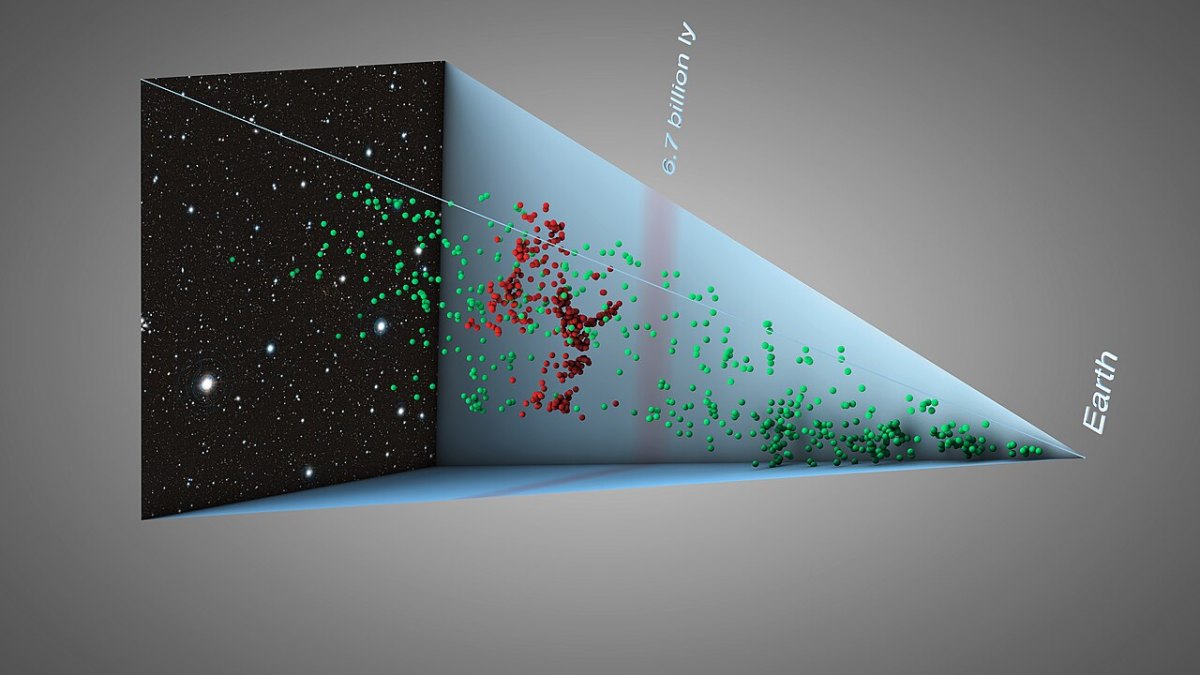
Astronomers have made a monumental discovery by identifying a galaxy located 14 billion light-years away from Earth, marking it as the farthest galaxy ever observed. Named HD1, this galaxy challenges current astronomical models and pushes the boundaries of our understanding of the universe. The light from HD1 has taken nearly the entire age of the universe to reach us, providing a glimpse into an era just 300 million years after the Big Bang, which occurred approximately 13.8 billion years ago. This discovery was made possible through the collaborative efforts of teams utilizing various telescopes worldwide, including the Subaru Telescope in Hawaii and the VISTA Telescope in Chile.
Discovering HD1: A Breakthrough in Astronomy
The discovery of HD1 was announced by an international team of astronomers led by Yuichi Harikane from the University of Tokyo. Utilizing data from multiple observatories, including the Atacama Large Millimeter Array (ALMA) and the Hubble Space Telescope, the team was able to confirm the galaxy's staggering distance. HD1's redshift, a measure of how much the universe has expanded since the light left the galaxy, is calculated to be at z=13.3. This redshift value was crucial in determining its age and distance, surpassing the previous record-holder, GN-z11, which was located 13.4 billion light-years away. The discovery of HD1 not only sets a new distance record but also provides critical data to refine our understanding of galaxy formation.
The Implications of a 14-Billion-Year Journey
Understanding HD1's properties offers significant insights into the early universe's conditions. The galaxy is believed to be forming stars at an extraordinary rate, possibly producing over 100 stars per year, which is ten times more than typical galaxies of its time. This high star formation rate suggests that HD1 may host Population III stars, the first generation of stars formed from primordial hydrogen and helium, devoid of heavier elements. These stars would be massive, luminous, and short-lived, providing clues about the chemical enrichment of the universe. The potential presence of Population III stars in HD1 could revolutionize our understanding of stellar and galactic evolution in the nascent universe.
Technological Marvels Enabling the Discovery
The identification of HD1 was made possible through the synergy of cutting-edge technology and international collaboration. Instruments such as the James Webb Space Telescope, launched in December 2021, are expected to provide even more detailed observations of HD1 in the future. These advanced telescopes can detect faint signals from ancient cosmic objects by observing in infrared wavelengths, where the universe's expansion has shifted the light. The use of gravitational lensing, where massive objects like galaxy clusters bend light to magnify distant galaxies, also played a role in identifying such a remote galaxy. These technological advancements underscore the dynamic progress in observational astronomy and the quest to explore the universe's depths.
The discovery of HD1, a galaxy 14 billion light-years away, underscores the vastness and complexity of the universe. It challenges existing theories about the early universe and provides a unique opportunity to study the conditions shortly after the Big Bang. As astronomers continue to explore the cosmos with ever more sophisticated tools, each new discovery like HD1 brings us closer to unraveling the mysteries of our cosmic origins.
- HD1 is located 14 billion light-years away, making it the farthest known galaxy.
- The discovery was confirmed using data from ALMA and the Hubble Space Telescope.
- HD1's high star formation rate suggests the presence of Population III stars.
- Technological advances like the James Webb Space Telescope will further study HD1.
- Gravitational lensing aided in the detection of this distant galaxy.
💬 Discussion (0)
Leave a Comment