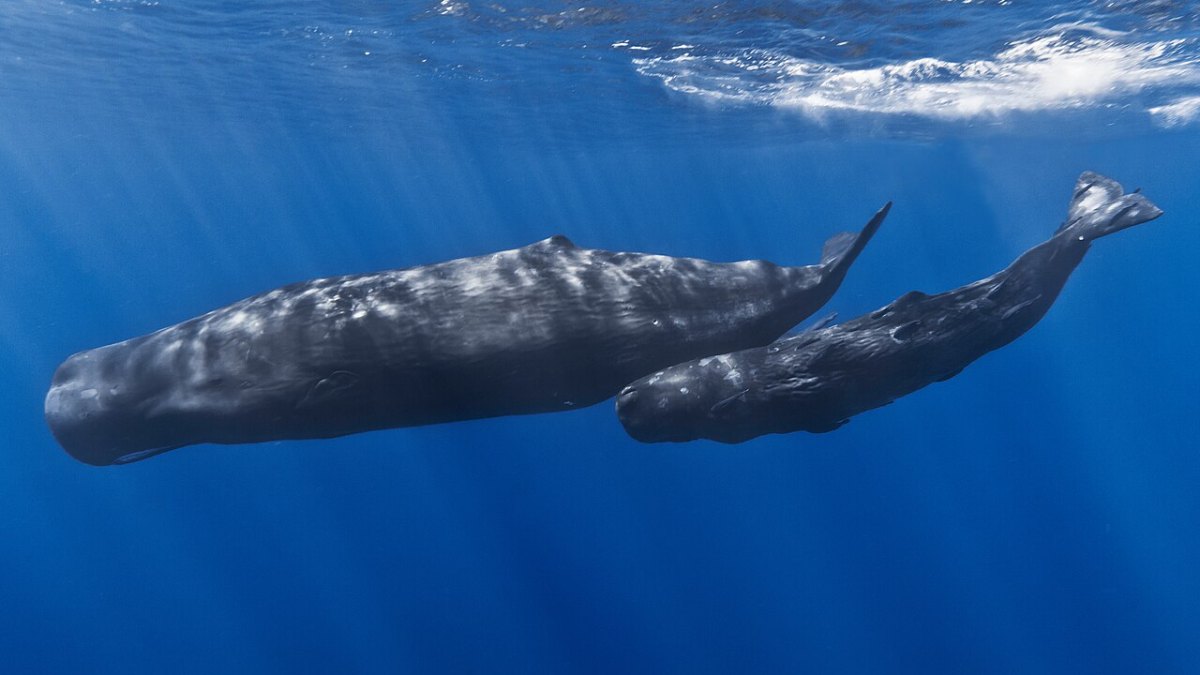
The sperm whale (Physeter macrocephalus) is a champion of extremes. It is the largest toothed predator on Earth, with adult males reaching 16 meters long and 57 metric tons. It has the largest brain of any animal that has ever lived, weighing about 7.8 kilograms. It dives to over 2,250 meters in pursuit of giant squid. And it produces, by a wide margin, the loudest sound any animal has ever been measured making: clicks at up to 230 decibels at the source, in the water.
What 230 decibels actually means
The decibel scale is logarithmic. An ordinary conversation is about 60 dB. A jackhammer at one meter is about 100 dB. A jet engine at 30 meters is around 140 dB. A rifle fired next to your ear is about 170 dB.
The sperm whale's click, measured at one meter from its head in seawater, has been recorded at 230 dB re 1 μPa. After the standard correction for the difference between underwater and airborne reference levels, that comes to roughly 167 dB in air-equivalent terms — still louder than the loudest non-explosive sound a human-made source can produce. In water, where the reference pressure is different, the number stays at 230, and the actual energy in the wave is staggering.
The biological cannon
The sperm whale's enormous box-shaped head, which makes up about one-third of its body length, is essentially a click-producing instrument. Inside the head sit two oil-filled organs — the spermaceti and the junk — which together act as an acoustic lens.
The whale forces high-pressure air through narrow nasal passages into a structure called the monkey lips at the front of the head, producing a sharp percussive click. That click reflects off the back of the skull, focuses through the spermaceti and junk, and exits the front of the head as a tightly directed beam. The whole apparatus is, in effect, a biological sonar transducer the size of a small car.
Echolocation, and possibly stunning
The clicks serve primarily as echolocation: the whale uses returning echoes to map the dark deep sea and locate squid up to 500 meters away. But marine biologists, including Bertel Møhl and his colleagues at Aarhus University whose 2003 paper first quantified the 230 dB figure, have proposed that at very close range the pressure wave is also a hunting weapon. Sperm whales have been observed hovering near small schools of fish and emitting bursts of intense clicks; some of the fish go limp and sink, suggesting the sound has stunned or killed them — a "big bang hypothesis" still under active investigation.
Why a swimmer is not vaporized
If you were unlucky enough to be in the water near a clicking sperm whale, would you die? Probably not. The beam is narrow and directional. At 10 meters off-axis, the level drops dramatically. At 50 meters it would still be loud — the equivalent of standing next to a chainsaw — but not lethal. Researchers tag and follow sperm whales in small boats every day without incident.
Inside the beam at close range, however, the situation would be different. Tissue can be torn by sufficiently intense pressure waves; the ears would lose their hearing first. Mercifully, the animal that owns this acoustic weapon is also one of the gentlest large predators in the ocean, and known cases of sperm whales harming humans intentionally are vanishingly rare.
💬 Discussion (0)
Leave a Comment