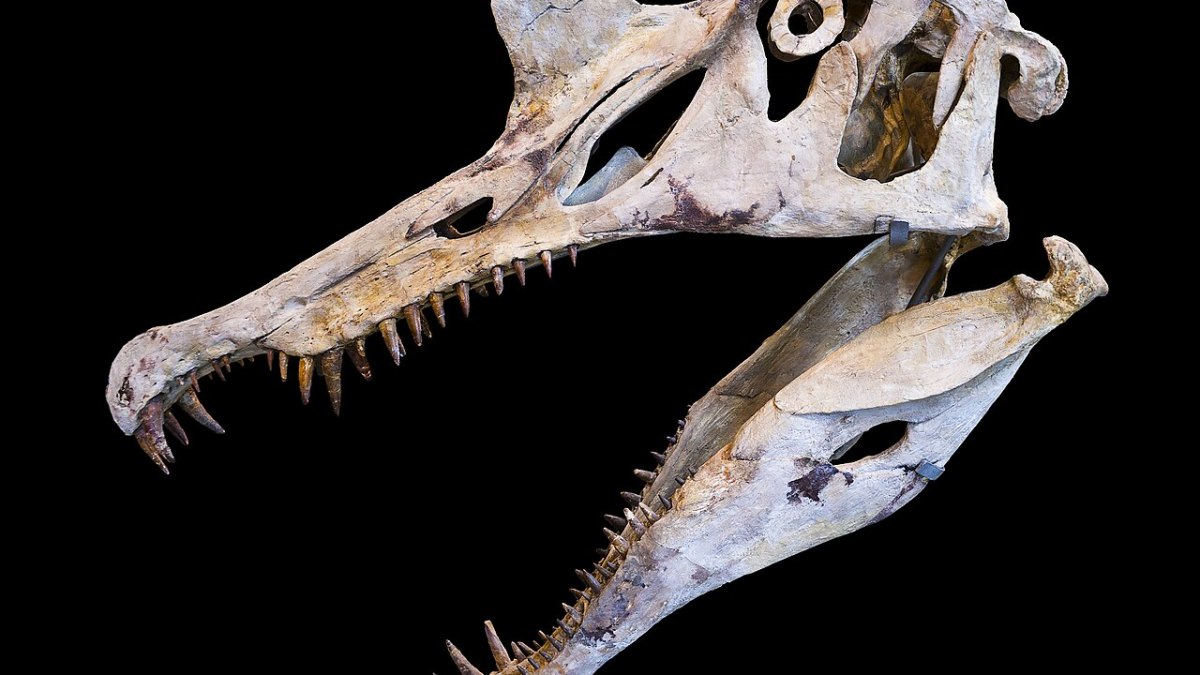
Imagine a predator so large it dwarfed even the mighty Tyrannosaurus rex. Enter Spinosaurus aegyptiacus, the largest known carnivorous dinosaur, weighing an estimated 20,000 pounds and stretching over 50 feet in length. Discovered in the early 20th century by German paleontologist Ernst Stromer, this massive creature roamed the planet around 100 million years ago during the Cretaceous period. What sets Spinosaurus apart is not just its size, but its unique adaptations for an aquatic lifestyle, a rarity among dinosaurs of its size and predatory nature. Its elongated, crocodile-like snout and conical teeth suggest it hunted primarily in water, preying on fish and perhaps other aquatic creatures.
The Discovery and Misfortune of Spinosaurus
The story of Spinosaurus aegyptiacus began with its discovery by Ernst Stromer in 1912 in the Bahariya Oasis of Egypt. The initial fossils included parts of the skull, vertebrae, and sail-like spines. However, these invaluable fossils were lost during World War II when the Munich museum housing them was bombed in 1944. This loss left scientists with only Stromer's detailed drawings and descriptions for decades. It wasn't until the early 21st century that new discoveries in Morocco began to fill in the gaps, providing more insight into the anatomy and lifestyle of this enigmatic creature. The rediscovered fossils, including bones from the legs and pelvis, have helped researchers understand its semi-aquatic adaptations.
Unraveling the Unique Anatomy
Spinosaurus aegyptiacus possessed several anatomical features that made it stand out among large theropods. Its sail-like structure, formed by elongated neural spines, is perhaps its most distinctive feature. This sail possibly served multiple purposes, such as thermoregulation, display for attracting mates, or intimidation of rivals. Its long, narrow skull, filled with conical teeth, was well-suited for catching fish. Unlike other large theropods, Spinosaurus had relatively short hind limbs, which some scientists suggest were adapted for an aquatic environment. Recent studies have even proposed that its hind limbs were webbed, aiding in swimming. These adaptations indicate a lifestyle that was not purely terrestrial, setting Spinosaurus apart from its contemporaries.
The Apex Predator's Diet and Hunting Strategy
Spinosaurus aegyptiacus is believed to have been an apex predator with a diet primarily consisting of fish, supported by its crocodile-like jaw structure and conical teeth. Evidence from isotopic analysis of Spinosaurus fossils shows similarities to modern-day marine animals, suggesting a significant portion of its life was spent in water. Its anatomical adaptations, such as the position of its nostrils high on its skull, would have allowed it to breathe while partially submerged. Moreover, its robust forelimbs and claws could have been used to catch slippery prey or pull itself along shallow riverbeds. The combination of these features paints a picture of a versatile hunter, capable of exploiting both terrestrial and aquatic environments.
Spinosaurus aegyptiacus remains one of the most fascinating and studied dinosaurs due to its unique adaptations and massive size. Its rediscovery and subsequent research have provided invaluable insights into the diversity and complexity of dinosaur life during the Cretaceous period. As more fossils are unearthed, the story of Spinosaurus continues to evolve, offering a glimpse into a world dominated by these ancient giants. The ongoing research promises to uncover more about its ecology and behavior, reinforcing its status as a true marvel of prehistoric evolution.
- Spinosaurus fossils were first discovered in Egypt in 1912.
- The original fossils were destroyed during World War II in 1944.
- New discoveries in Morocco have provided further insights into its anatomy.
- Spinosaurus is one of the few known semi-aquatic dinosaurs.
- It likely hunted fish and other aquatic prey with its crocodile-like snout.
💬 Discussion (0)
Leave a Comment